

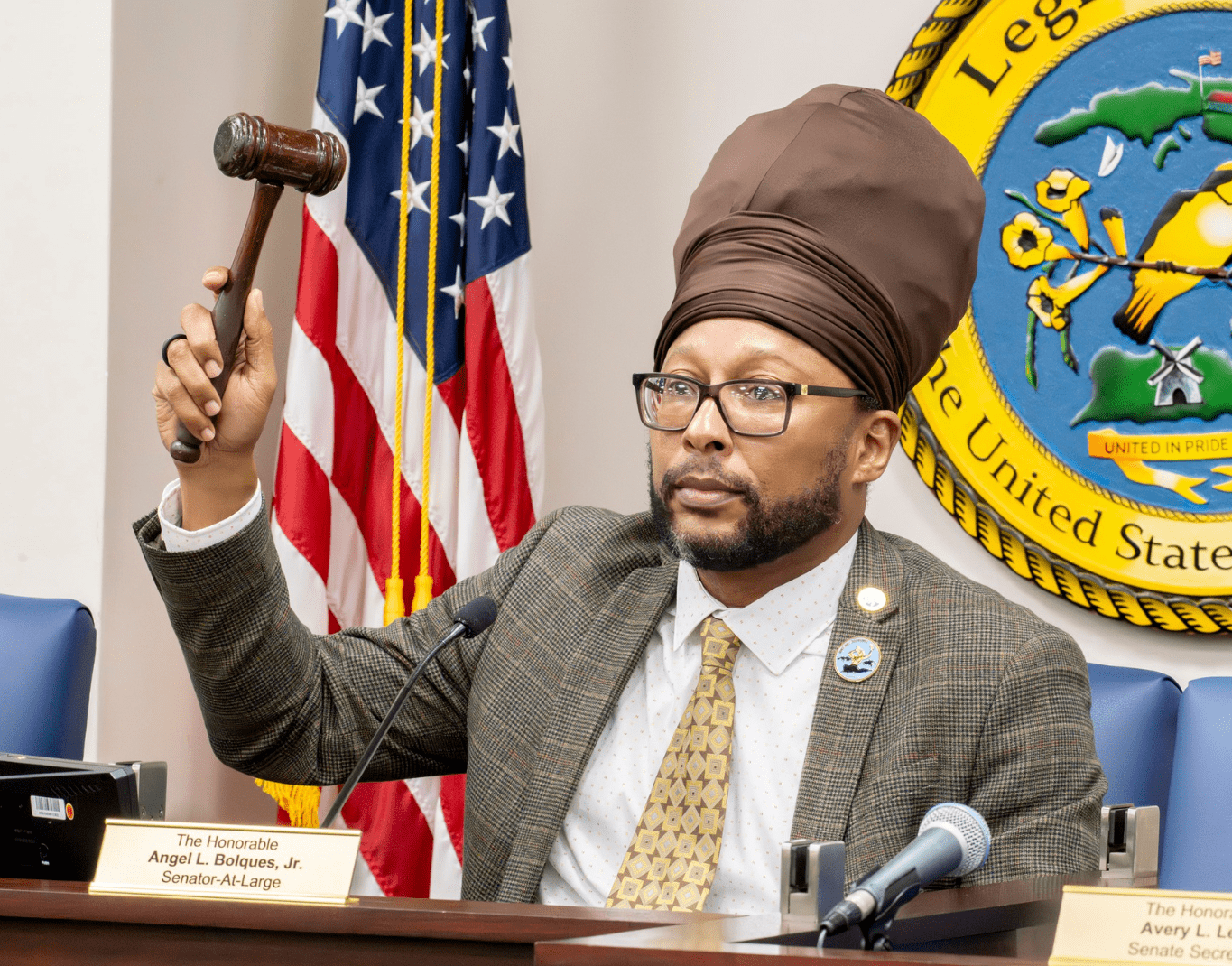
Lawmakers expressed deep frustration Monday at the Senate Culture, Youth, Aging, Sports and Parks Committee hearing over years of delays and rising costs tied to the unfinished Paul E. Joseph Stadium, as officials acknowledged the project is running out of money and may miss yet another deadline.
The stadium, first started in 2013, has spanned three governors and four public works commissioners without being completed, with costs climbing to more than $32 million.
Committee Chair Sen. Angel Bolques Jr. reminded witnesses that under subpoena last year, officials and the contractor promised the stadium would be finished by December 2025.
“It was clearly stated on the record … that the stadium would be completed in December 2025 … and unfortunately, that commitment has not been kept,” Bolques said, noting that more than $32 million in public funds has already been spent on a project “that is still not finished.”
The contract now runs through July 2, while the contractor’s schedule extends into late September.
Public Works Commissioner Derek Gabriel testified that roughly $6.1 million remains available for the Paul E. Joseph project, but said that amount, and the pace at which it can be spent, is not enough to complete the stadium on the current schedule. He noted that portions of the remaining funds are already committed to specific items, such as the press box and generator, leaving little flexibility to accelerate work.
“Just given what we’ve seen in the last few months, I don’t think that we have the cash flow sufficient to finish the project in the timeline identified,” Gabriel said. “It’s not like we’re hiding cash. We don’t have it to be able to finish.”
He said the shortfall now demands “frank, candid, closed‑door discussions” between senators and the administration about whether to inject more money into the contract, scale back expectations, or consider more drastic options.
Contractor John Wessel, managing member of GEC LLC, argued that the latest delays are driven less by his firm’s performance and more by the government’s failure to pay on time. He maintained that the stadium can still be delivered if cash begins flowing under the terms of the contract.
“There is no daily manpower on site, and that goes hand in hand with my staffing plan, because it has to do with the lack of payments,” Wessel said. He added that key materials, including a redesigned chain‑link outfield fence, cannot be ordered until outstanding delay costs are paid.
Gabriel, however, told lawmakers that the problems cannot be pinned solely on slow payments. “I would give everybody a 33 and a third percent,” he said, dividing responsibility among government decisions, contractor performance and design changes that reshaped the project midstream.
Officials said the project expanded significantly after it began, moving into a FEMA-designated floodway and requiring major engineering changes and federal approvals.
“The suspension resulted in a complete revision of the construction contract, design of the stadium, size of the stadium doubled, and relocation of the stadium into a floodway,” Wessel testified.
Office of Disaster Recovery Director Adrienne Williams-Octalien said the new site required a deep-pile foundation and elevation changes before FEMA approved a conditional letter of map revision in 2021. Wessel added that foundation failures and redesigns further delayed construction.
Many lawmakers rejected Wessel’s attempt to shift the focus to late payments, pointing instead to years of missed deadlines under his watch and the stadium’s continued shutdown more than a decade after construction began. They said the community has paid the price in lost money, lost trust and lost playing time for local athletes.
Several senators said the decade-long saga has already damaged public trust and deprived young athletes of opportunities.
“You have been a disaster to St. Croix with this project,” Sen. Franklin Johnson told Wessel, adding, “You’re never going to finish this project. I said I have no confidence in you finishing it.”
Sen. Alma Francis Heyliger called the situation “a whole mockery,” saying, “Long and short, this is a waste of money … The people of this territory got shortchanged.”
Sen. Novelle E. Francis Jr. said he “can’t continue to imagine the amount of talent that have been delayed and denied” because the field remains closed. Bolques added that it is “difficult” to continue funding the project under the current contractor.
Despite frustration with GEC’s performance, Public Works Commissioner Derek Gabriel told senators that replacing the contractor at this stage could increase costs and extend delays.
“It is our professional assessment that doing so would cost up to an additional $10 million and delay the project by at least eight to 24 additional months,” he testified. “If we were to pivot … that list of risks grows exponentially.”
For now, he said, continuing with the current contractor remains the most practical option unless lawmakers are prepared to appropriate significantly more money. Pressed on whether he has confidence in GEC, Gabriel was cautious.
“It’s difficult to say … the project is rife with challenges, particularly cash flow,” he said, noting that the contractor maintains he can finish if the remaining funds are fully available.
Beyond finishing construction, officials warned that the stadium will carry ongoing costs. Sports, Parks and Recreation Commissioner Vincent Roberts estimated annual operating expenses between $1.5 million and $2.2 million, driven by staffing, utilities and maintenance.
“Facilities of this nature are not typically profit-generating,” Roberts testified, adding that their value is measured more by “economic activity, community engagement and utilization, not solely direct revenue.”
Bolques said the project carries community significance beyond its cost and timeline.
“We deserve a facility that honors the legacy of Paul E. Joseph,” he said. “We deserve the cultural and sporting life that this stadium was built, or supposed to be built, to support.”