

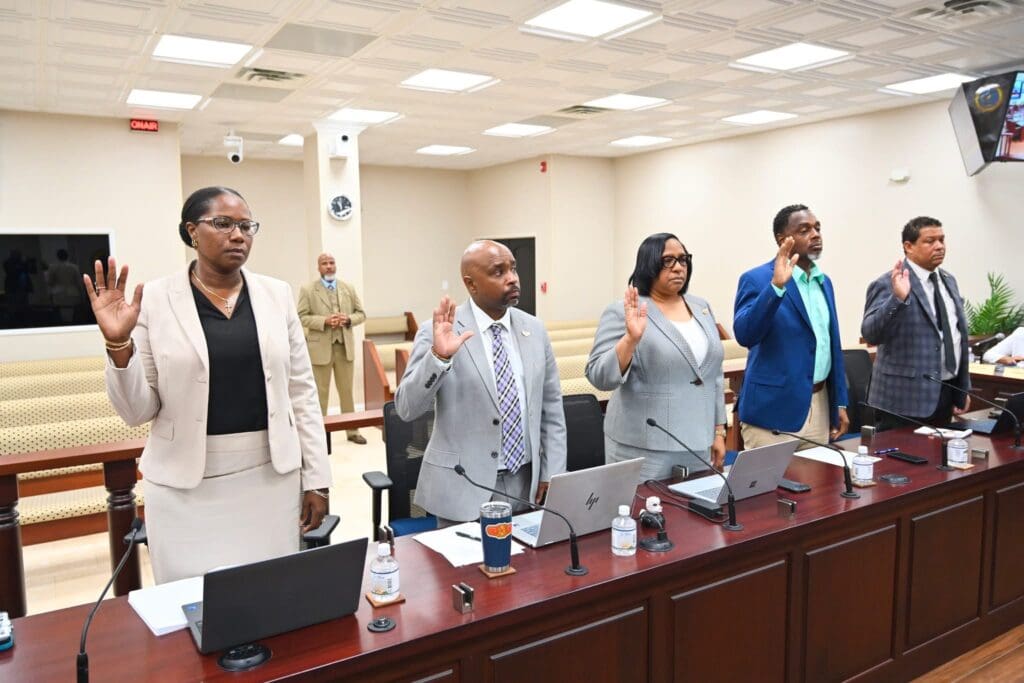
After months of delays and missed hearings, several key officials and the contractor behind the Paul E. Joseph Stadium project finally appeared before the Senate – some under subpoena – on Friday to explain why, more than a decade after the first contract was signed, the stadium remains unfinished.
At the heart of the testimony was a pattern of escalating costs and shifting designs. The project was initially contracted to GEC, LLC in December 2014 for $20 million, with an anticipated completion date of June 2017. According to GEC Managing Member John Wessel, the original design called for a larger stadium on the existing footprint, incorporating the reuse of the stadium’s concrete outfield wall and lights. But that plan changed just months later, when then-Gov. Kenneth Mapp issued a stop-work order in early 2015, requesting a revised design that relocated the stadium into a FEMA-designated floodway.
That decision, Wessel said, created years of complications. “Had we not been required to redesign the foundations due to the floodway relocation, the project likely would have been completed by 2017,” Wessel told senators. Instead, FEMA-mandated design changes, including deep pile foundations, led to significant delays and additional permitting hurdles.
By 2019, escalating costs prompted Gov. Albert Bryan Jr. to order a redesign aimed at scaling back the project to control spending, testifiers said. Wessel testified that the design changes requested by the Bryan administration eliminated features from the original plan, including the stadium’s announcer’s box and a planned scoreboard. “I follow what the client tells me to do,” Wessel said when pressed by Sen. Marise James about why he hadn’t objected to removing key stadium elements. “As a design-build contractor, I deliver what the owner requests.”
The result of these cumulative changes: 24 change orders and two supplemental contracts totaling over $9 million on top of the original contract price. According to Property and Procurement Commissioner Lisa Alejandro, the department processed two formal supplemental contracts with GEC: the first in February 2022 for $4.1 million, and the second in September 2024 for $5.124 million.
These latest additions, authorized under Act 8781, included scope elements that were originally planned but later removed and subsequently reinstated: perimeter fencing, a concrete outfield wall, fiber optic utility relocation, a 750 kW generator, WTJX communications stations, and the relocation of sewer lines around Terrence Martin Field. Also added was revised site lighting using solar technology, and several design revisions required to comply with FEMA’s flood zone regulations. Wessel explained that many of these additions were necessary for operational functionality, including the outfield wall and generator.
“Effectively, after removing features to save costs, the government decided to restore much of what had been taken out—though at a higher price,” Wessel noted.
Permitting delays compounded the problem. Planning and Natural Resources Commissioner Jean-Pierre Oriol confirmed that FEMA approvals, including a Conditional Letter of Map Revision (CLOMR), were not secured until early 2021. DPNR had to issue multiple permits at different stages—demolition, earthwork, foundation, and utilities—with Oriol noting, “the stadium’s relocation into the floodway drove much of the delay.”
Meanwhile, Public Works Commissioner Derek Gabriel placed current project completion at “70 to 75 percent” under questioning from Sen. Marvin Blyden. Gabriel detailed that current work includes roofing, mechanical and electrical systems, and construction of Terrence Martin Field’s foundation. He acknowledged that the project’s oversight rests primarily with Public Works, though coordinated review of change orders involved Property and Procurement, the Office of Disaster Recovery, and the Department of Sports, Parks, and Recreation.
DSPR Commissioner Nominee Vincent Roberts reiterated the department’s frustration with delays, emphasizing the need for a facility capable of supporting youth leagues, cultural festivals, and sports tourism initiatives. Roberts noted that DSPR’s role as the project’s end-user had required constant engagement to ensure the stadium met practical operational standards. “We also raise concerns when project delays or design changes threaten to compromise the stadium’s intended use,” he told lawmakers.
As for the stadium’s completion, Wessel cautioned that while current construction continues, additional funding may be required to cover delay-related costs—funds not yet identified by the government. “Funding for accumulated delay costs remains unresolved,” he testified.
Originally envisioned as a $20 million project with a 30-month schedule, the Paul E. Joseph Stadium redevelopment has now stretched to an estimated $35 million-plus undertaking with a revised completion date of December 25, 2025. Whether that date holds, lawmakers heard repeatedly, depends on resolving the project’s final design adjustments and funding gaps.