

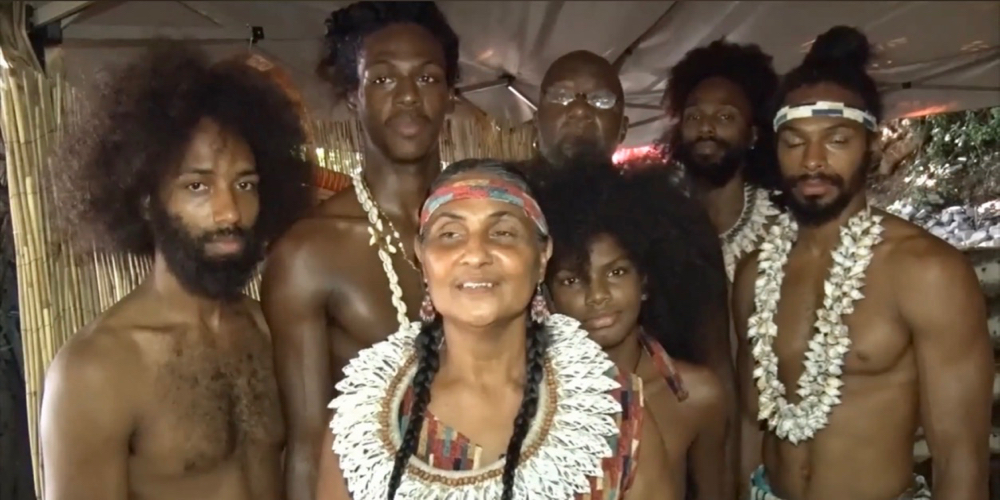
During the first week of January, Gov. Albert Bryan Jr. vetoed six bills. Among them was Bill No. 33-0364, which sought to create a Virgin Islands Indigenous Tribe identification card for those who identify as Taino, Carib, Kalinago or any other Caribbean indigenous group.
The governor’s veto engendered little public conversation, but it was a setback for Maekiaphan Phillips, a St. Thomas woman who has been pushing the Virgin Islands government for tribal recognition for eight years.
Phillips has been named the “kasike” (“cacique” in Spanish) or “chief” of the Guainia Taino Tribe of the Virgin Islands, the first named chief in the Virgin Islands in hundreds of years.
“We thought it best to link our tribal name to our Taino brothers and sisters in Puerto Rico; Guainia also links us back to the Amazon and Venezuela,” she said.
For those who are unfamiliar with the term “Taino,” it refers to “the Arawakan-speaking peoples of the Caribbean who arrived from South America over the course of 4,000 years,” according to National Geographic.
In Puerto Rico, the Dominican Republic, Cuba and now the Virgin Islands, the term “Taino” is generally preferred over the term “Arawak.”
This is the second in a series about Taino culture and history as it relates to the Virgin Islands.
“For many, many years Maekiaphan Phillips and her husband Tesroy Phillips and their 12 children, have worked tirelessly to prove their Native American ancestry, obtain federal tribal recognition and share their culture and heritage with others,” said Suzanne Darrow Magras, an educator who has assisted Phillips in her efforts to gain tribal recognition.
Phillips has gathered island residents for ceremonies, made presentations for school children and community groups and established a nonprofit group, Opi’a Taino Int’l. Its mission is “to promote the restoration, respect and education of the ‘Spirit’ of Taino, Arawak, Carib and other indigenous cultural heritage, history, arts, sciences and traditions,” Darrow Magras said.
On Aug. 9, 2017, Phillips held a pow-wow on St. Thomas on the 10th anniversary of the establishment by the United Nations of International Day of the World’s Indigenous People. Among her supporters was (now retired) Sen. Myron Jackson who has acknowledged his own indigenous roots.
“On this day we reflect on the sacrifices of the indigenous people of the Virgin Islands, who survived against all attempts to decimate them in many instances, and who have made their lasting impression upon our society. Some of us have stories passed down through oral history of our ancestry,” Jackson said that day in a statement. “Today we stand in gratitude for the strength and courage of their descendants who continue to keep their traditions alive.”
Jackson made multiple attempts to enact legislation granting recognition of indigenous heritage among Virgin Islanders, but each failed. Proposed bills died in committee in 2014 and 2016. In September 2020, the V.I. Senate Committee on Culture, Historic Preservation and Aging approved Bill No. 33-0364, and the measure was then passed by the full Senate.
The bill would have authorized the Virgin Islands State Historic Preservation Office to establish criteria recognizing the U.S. Virgin Islands indigenous tribes as official Indian tribes of the territory. It also mandated the Bureau of Motor Vehicles to issue ID cards.
Gov. Bryan vetoed the bill in January.
“This issue, unfortunately, has been abused by certain persons claiming to be Sovereign Nation Persons who [claim they] are not subject to laws of the United States of America or the territory,” Bryan said. “This matter needs more critical discussion and redrafting.”
Bryan said the legislation before him lacked “sufficient definition of requirements for providing proof of qualification, strict requirements for indigenous peoples’ organizations to identify their members and limitations to the use of the identification card and any perceived rights beyond identification.”
Phillips responded, “I understand Gov. Bryan is being cautious and by right he should be. I realize the innocence of this bill that I started back in 2012 was tainted when I heard many of the testifiers and their vision. Opi’a Taino and the Guainia Taino Tribe of the Virgin Islands got caught up in something that we had nothing to do with.”
Phillips said the original intent of her bill was lost. She said she not invited to meetings that were pertinent to her cause, “therefore, how could my words be heard; how could my purpose be conveyed? This is why when I got a text telling me unfortunately the governor vetoed the bill, I did not get angry.”
The full text of Phillips’ response to Bryan’s veto can be seen in the Source Opinion section.
The bill leaves a lot of difficult questions unaddressed. First, it lists an array of indigenous cultures that must be recognized, from Taino to Arawak. But since none of these entities exists anymore (in the Virgin Islands) as a living culture, with institutions, language and traditions, how are these groups to be defined? Even genetic tests are not going to say which indigenous culture, just that they contain indigenous DNA.
As the governor pointed out, there are genuine questions regarding how much DNA would be required for an individual who identifies as Taino to qualify for membership in the tribe. When Sen. Elizabeth Warren referred to her own Native American ancestry during her 2012 campaign for the U.S. Senate, it was latched onto and in 2016 then-presidential candidate Donald Trump used it to ridicule her with the nickname “Pocahontas.”
Finally, recognized U.S. Indian tribes have the authority to pass some laws and enforce them on tribal lands. It’s not at all clear the Virgin Islands government has the right to grant a subset of U.S. citizens any governmental powers without explicit congressional authority, any more than the USVI could recognize St. John as an independent country.
Phillips had hoped that passing legislation would move the conversation about tribal recognition forward. She plans to continue her attempts to mobilize around the issue.
– Taino Today Part One: Descendants Challenge
Outdated Extinction Theory