

Bernard Cuffy said he hoped to give his 28-year-old son the land he purchased in Estate Clairmont as a wedding gift. But access to that land is now a legal dispute between Cuffy and residents on neighboring plots.
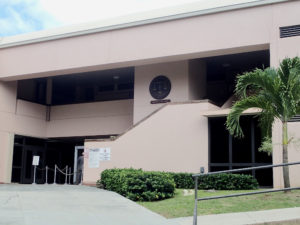
Judge Jomo Meade heard testimony from both sides during a Superior Court hearing at the Richard Herbert Amphlett Leader Justice Complex Monday.
In a formal complaint dated April 17, 2018, the plaintiffs ask the court to force Cuffy to “stop unlawfully cutting a road” on their properties. But two representatives from the Department of Planning and Natural Resources testified that Cuffy had a right to clear the road to gain access to his property during Monday’s hearing.
Leia LaPlace, DPNR’s territorial planner for the Division of Comprehensive and Coastal Zone Planning for the past four years, said she had reviewed two certified maps of the area and verified that there was an “easement” that could be used as a roadway to Cuffy’s property.
Emanuel Liburd, DPNR’s earth change and land clearing officer for the past 10 years, said the process for granting a permit to clear land included reviewing maps and deeds and verifying if there was a feasible plan to accomplish the applicant’s goal. Liburd said he visited Estate Clairmont to inspect the path leading to Cuffy’s property but got to a point where he couldn’t go any further because it wasn’t cleared.
But according to Liburd, there were maps confirming that there was an actual path to the property. Based on his site visit and the maps, he approved a land clearing permit, he said.
The plaintiffs’ attorney, Mark Eckard, asked LaPlace if the permit allowed for grading or constructing a road. LaPlace said that it could. She also testified that according to Virgin Islands law, there shouldn’t be land-locked properties.
Who Controls the Easement
There was a lot of debate over what to call the disputed path leading to Cuffy’s land. Eckard often referred to it as a shared roadway. He asked LaPlace if the property owners on surrounding plots also owned the roadway.
“No, it’s an easement,” she said. “They pay taxes on it.”
Eckard posed several questions to both LaPlace and Liburd over who actually controlled the path and who had a say on how it should be used.
LaPlace said if there isn’t a home owner’s association, it would be “unclear” who controls the easement.
While questioning both LaPlace and Liburd, Eckard pointed to maps where hash lines indicating the boundaries of the plaintiffs’ properties seemed to coincide with the disputed easement. He asked Liburd how DPNR could grant a land clearing permit to one property owner without notifying others who might be affected.
Liburd initially said the map that Eckard showed him marks the easement as an “ROW” or right of way, which gives DPNR the right to allow Cuffy to clear the path for access. Eckard then said the map shown was one Cuffy had submitted and pointed to the maps that the DPNR representatives had used to make their assessment.
Eckard asked Liburd if any of those maps indicated a right of way, a road, or an easement. Liburd testified that they didn’t, but later said that the marking “ROW” wasn’t necessarily a requirement for an earth change permit to be approved. He said that once a path is established as a way to access someone’s property, a permit could be approved.
The plaintiffs’ lawyer continued to bring into question the neighboring owners’ rights to the easement. According to Liburd, “they have a right to use it” but they don’t have a right to block someone from clearing it to gain access to purchased property.
History of Out-of-Court Debates
Monday’s debate is a fight that predates legal hearings.
Cuffy said he bought the land from the government in August of 2017 after it was advertised as a repossessed property up for sale. The Carpet Masters business owner said he later called one of the residents who lived on neighboring property to alert her that he had purchased the land and would be clearing a roadway to access it. The resident, Cynthia Devlin, didn’t respond to the call but later responded to a text, according to Cuffy.
Cuffy’s attorney, Gertrude LeCoint, asked Cuffy to read the entire text message chain that followed. Cuffy then read the chain from a document that had been submitted into evidence for the case.
The chain begins with Cuffy informing Devlin, who is now a plaintiff in the case, that he had purchased the land and had plans to visit it.
“Interesting. What plot? How can I help?” Devlin responded.
Cuffy said that he had purchased plot number 38 and detailed the boundaries of the property.
“Gosh. Have to look online. Great. Welcome to the hood. Chat early next week,” Devlin said via text.
“I plan on going through the overgrown road,” Cuffy wrote back. “I didn’t want to startle you or the neighbors.”
“Wow. Let’s chat. Thanks for writing. We’ll get back to ya,” Devlin responded.
Both Cuffy and his wife, Athlene Cuffy, testified that Devlin and her husband along with other residents and home owners of neighboring properties subsequently invited them to a cocktail party to discuss the roadway on October 7, 2017.
According to Athlene Cuffy, the cocktail party started with a warm welcome to the neighborhood.
“They had crackers and cheese and some wine and hot dogs,” her husband said in a supporting statement. “They started welcoming us.”
But the conversation eventually evolved from a social dialogue to a business meeting, according to the Cuffys. Athlene Cuffy said that Brian Devlin, Charles Adams, and Austin McKenzie – plaintiffs in the case – rolled out maps and showed them the roadway. Both husband and wife said that they were then asked to sign documents, which acknowledged that they had rights to the roadway as property owners but that they would relinquish those rights.
According to Bernard Cuffy, the reasons given were issues with security and a story of a previous owner who had been tied in a building 15 years before. He said that he and his wife suggested an electronic gate for added security but there was no response to their suggestion.
Athlene Cuffy said that, at one point, Cynthia Devlin showed her the roadway from the Devlins’ terrace.
“The road was the backyard,” she said. “The backyard was in the road.”
According to the defendant’s wife, the warm behavior she experienced in the beginning “changed a little bit” when she and her husband said they wouldn’t sign on the spot without reviewing the documents.
The situation would ultimately escalate into hostility when the Cuffys decided not to sign at all, according to testimonies from the husband and wife and the formal complaint from the plaintiffs.
Cuffy said that he was led to believe there was a homeowner’s association and that he was going against their wishes because he was unwilling to sign. Later research proved there was no actual homeowner’s association, according to Cuffy.
The defendant testified that he proceeded to clear the path in attempts to create a roadway, even before he had received an earth change permit from DPNR. But the roadway was never cleared – even after he received the earth change permit – because his neighbors made sure he couldn’t do it, Cuffy said.
According to Cuffy, his neighbors blocked his efforts by placing large boulders at the entrance of the roadway and called the police on him four times. Whenever the police arrived, he’d have to show identification and proof that he owned the property, he said.
At one point, a neighbor’s son threatened to smash the windows of his car, Cuffy said.
But according to the complaint that the plaintiffs’ filed against Cuffy, he exchanged his share of hostility too.
The written statement alleges Cuffy “angrily shouted at plaintiffs: ‘I don’t give a rat’s a**!’ and ‘I don’t give a f***!!’ ” in response to their verbal protests against the land clearing. In another instance, Cuffy pointed his finger at two of the plaintiffs and screamed “I’m going to get you!” according to the complaint.
Eckard objected to testimonies about the Cuffys alleged interactions with his clients, arguing that they were “hearsay” on “out-of-court statements” and irrelevant to whether or not Cuffy had a right to clear the path in question. LeCoint argued they were necessary to prove that the current legal dispute was one rooted in wrongful intentions.
“The reason why we’re here – all of it has to do with malice,” she said. “It has to do with fraud.”
Meade overruled Eckard’s objection, but often stopped the husband and wife in the middle of their testimony to warn them when they delved into “hearsay” territory. He often coached the witnesses on how to testify, telling them they could only say what they understood from a discussion but could not directly say that one of the plaintiffs said something.
Eckard also argued that the testimonies inappropriately disclosed settlement discussions. Meade, in response, said the discussions predated the legal battle and could not be characterized as settlement discussions. The judge overruled this objection as well.
Concerns Over Feasibility of Road Construction
In their complaint, the plaintiffs also express concern over the feasibility of road construction in the disputed area, arguing that it contains a protected mahogany tree and pedestal from the Virgin Islands Water and Power Authority. Eckard also mentioned a VIYA pole during one of his cross examinations.
Cuffy said he was hiring someone who inspected the road and that person told him that it was possible to work around the WAPA pedestal, a septic tank located on the path, and another pole until those units could be removed. He said trees could be removed. According to Cuffy, the pathway is about 30 ft. wide so it allows a lot of room to work around the units.
Eckhard asked how Cuffy planned to deal with underground lines to which Cuffy responded that claims that there were underground lines were false.
At one point during the questioning, Eckard and Cuffy went back and forth over maps of the area. Eckard repeatedly asked Cuffy to identify the boundaries of the plaintiffs’ properties and to discuss their rights to the roadway.
Meade openly expressed frustration over Eckard’s line of questioning during this cross examination. At one point, he told Eckard that the proceedings wouldn’t be dragged out if he were to ask “relevant questions”.
An Alternate Route
Plaintiffs have suggested that Cuffy doesn’t have to use the disputed route to gain access to his property. There’s another route, they say.
In court, Cuffy said that geo maps show that this route is a 70-foot incline and would cause him to have to create an additional roadway on his property, decreasing its value. He said the other route was more convenient.
In response to questioning from Eckard, Cuffy said he hadn’t done any topographical or erosion studies.
Ruling Delayed
Senators Allison DeGazon and Javan James were present towards the end of the hearing, which has garnered public interest after alleged reports that the dispute was a racial issue.
Though many anxiously await a decision from the court, there was no ruling on Monday. The court case resumes Tuesday at 10 a.m. The defense is slated to call two more witnesses.
Both Attorney Eckard and Attorney Akeel St. Jean, who also represented the plaintiffs, had no comment on the matter after Monday’s hearing. Two of the plaintiffs who were present also chose to remain silent on the issue.




Been reading the public commentary on this situation. Mr Cuffy also took his fight to the court of public opinion, which was about 95% in his favor. It seems that most people believe this is a racially motivated case, but some of the plaintiffs are black. Many also called for violence against the (white) plaintiffs. Could it be that people who have invested lots of money into their home and property are fearful of the value, beauty and peace being affected by road construction and future road noise? Could the Cuffy’s have listened to residents concerns and then expressed their concerns and plans? Perhaps neighborly communication on both sides could have prevented escalation of hostilities. But people want what they want, and most are not open to any agreement any more. I just hope that the public outrage regarding this personal matter, affecting a handful of people, does not spill over into violence against those whom about 95% of the population consider to be interlopers and enemies.
Native homeowners should be respected, as others moving there expect to be. There is no “white only” community in the Caribbean. Mr. Cuffy listened, was threatened, and had every right to turn to the community for support. I hope the mindset of new residents won’t invoke another uprising as in the 60’s. New residents should be neighborly and leave their racism on the mainland.
Every person should be respected. I do not believe this was a racial issue. I believe racism was the cudgel that was used to win public opinion in an area that is already primed and ready to believe it. I believe it was about fear of property values plummeting due to a road being cut into a previously undeveloped area. I don’t know of any belief that there should be “white-only” communities. That’s new to me. I sense fear in many that they are in danger of losing control if too many ‘others’ move here. We are a nation of rules based on fairness. The court system is an important way to ensure that. Mr. Cuffy was victorious in his argument based on the facts of the case. Alleged racism was not one of those facts. My fear is that this case has really struck a nerve in the “native” population, and they are now out for blood. The veiled threats “another uprising as in the 60’s”, or overt threats “shoot them”, are dangerous. I hope the native community has not found a scapegoat for their rage and resentment in the “new” residents, and resort to violence against them. Everybody needs to calm down.
Your response has a very racist undertone and reflect the underlying issue that remains the root of the problem. Are you saying that a native accessing his property and building his house will diminish property value? You are dumb and preposterously daft to even mention this. Racism was evident and he was threatened several times. The community should support each other when an injustice is evident.
Wow! You are really reaching! The property owners did not want a road cut into a previously undeveloped piece of land, for right or wrong. If here is another option for a roadway, wouldn’t you want to avoid disruption of excavation equipment? The way they went about trying to persuade Mr Cuffy was wrong. But Mr Cuffy was wrong to make it a public issue with alleged racist intent. Of course a community that is already primed for resentment of ‘others’ would jump on this. I just hope they control their baser instincts and seek peace. And your name-calling and insults are demeaning to you, not me.