

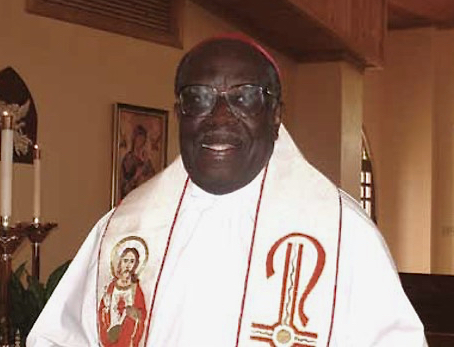
The life of Elliott Griffin Thomas proved one thing: It doesn’t take a crashing boom to make a lasting echo. A soft hum can resound well into the distance and quietly move a multitude.
Hundreds of people who were touched by his gentle call responded Friday, attending a Mass at Sts. Peter and Paul Cathedral and standing vigil as the former bishop of the Catholic Diocese of St. Thomas in the Virgin Islands was laid to rest in Western Cemetery.
Religious hierarchy attested to his status within the Catholic Church. Co-celebrants included Cardinal Sean O’Malley, cardinal of Boston and former bishop in the Virgin Islands, Cardinal Donald Wuerl, formerly head of the Archdiocese of Washington, of which the Virgin Islands is a part, and the Most Reverend Herbert A. Bevard, current bishop of the Virgin Islands.
The presence of leaders from other denominations – among them the Methodist, Episcopalian and St. Thomas Reform churches, the Coptic Orthodox and the St. Thomas Synagogue – illustrated the ecumenical approach to faith for which Thomas was noted.
Among the government dignitaries present were former governors Charles Turnbull and John de Jongh Jr., as well as Lt. Gov. Tregenza Roach and many current and former senators.
But the biggest crowd were the people he had worked with, preached to, counseled, cajoled, inspired, befriended and served.
At the Mass and after, in interviews with some of those who admired him or were especially close to him, the same word kept popping up: humble.
“A simple parish priest was all he wanted to be,” said Anna Mae Brown Comment, who said Thomas was “very supportive” when she was principal of Sts. Peter and Paul School.
Thomas had been pastor at St. Ann’s parish on St. Croix and was serving as pastor of Holy Family parish on St. Thomas when he was tapped first to be the administer of the diocese and then was named bishop – the first and so far only Caribbean person to hold that position. He served as bishop from late 1993 to 1999.
“It was quite an overwhelming assent for him that he hadn’t anticipated,” Comment said.
But it was one he embraced. In an interview published by V.I. Pride Magazine in January 1994, Thomas said, “I really find it frightening,” to be named bishop. “But God never sends us out to do a job unless He gives us the tools to do the job.”
“He faced many, many challenges as an administrator,” Bevard said. “He had that gift of being a team player … He had the welfare of the church in mind.”
Even in retirement, Thomas was a presence in the territory.
“He was patient and loving and very interested in other people,” Bevard said. “He consistently saw the good in people; he was very patient with people’s failures.”
Both Thomas and Bevard converted to Catholicism as adults, and Bevard recalled “we would talk about the experiences we had … He was interested in making the church attractive to all and he knew how to do that.”
In the Pride magazine interview with this reporter, Thomas said his parents, Damon Griffin Thomas and Helen Malvina Christopher Thomas, instilled a love of faith in him. They were highly religious Christians who took an active role in various churches.
Originally from Tortola, they were living with their young family in Pittsburgh in 1926 when Elliott was born, the fifth of eight children, six of whom lived to adulthood. They returned to Tortola when he was a young child and later to St. Thomas, where he graduated from Charlotte Amalie High School.
The bishop’s baby sister, (Bernice) Louise Thomas Heyliger, now 87, shared some of her early memories of her brother Saturday.
“I knew him as being kind and sort of mischievous,” she said.
The family lived simply and under loving but strict parental rules.
“We had a couple coal pots,” in lieu of a stove, she said, and “children had chores to do.” Elliott and brother Clarence had to draw water from the cistern, for instance, and each child took a turn at kitchen duty.
She recalled a favorite trick of Elliott’s. He would hide a dirty pan or two while a sibling labored over the kitchen clean-up. Just when the worker was sure the task was finally finished, Elliott would pull out one more greasy pot and present it with a comment to the effect of “You forgot this.”
But he could be very loving, too.
“I remember my first day at school,” Heyliger said. She had been eager to go because she often could hear the children singing and she loved to sing. But when the day finally came, Clarence scared her with talk of the teacher giving out spankings. She cried for hours and when it was time to go, an older sister and Elliott walked with her.
“Elliott held my hand,” she said. “It gave me the spirit to go on.”
Years later, when she was in college, he was still lending her support.
By that time, he had earned a bachelor of science degree from the College of Pharmacy at Howard University in Washington, D.C., served two years in the Army and was working as a pharmacist in Erie, Pennsylvania.
It was the 1950s. During the decade, the average annual salary in the U.S. grew from under, to a bit over, $3,000, according to on-line sources. At $3,500, that would mean a bi-weekly paycheck of about $130.
“Every other week, he’d get paid on Friday, and by Wednesday, I’d have a check for $15,” Heyliger said. It was so regular, even her friends came to count on it.
“It was a very nice thing to do,” she said.
And it was totally in keeping with their upbringing. Heyliger recalled that when she was a child, her grandmother lived with the family, and her parents gave her “the best room in our house.” They helped out other relatives and friends, too.
“Everyone was poor then,” she said, but “there was always something we could share.”
She recalled her mother’s admonition to her grown children: “A grain of rice can be divided in six. I don’t want to be dead and find out one is in need and the other is not sharing.”
Both parents were fond of biblical passages, and quoted frequently for various occasions, Heyliger said. As each child grew up and left home, her father would give him or her a Bible with an inscription “Trust in the Lord … In everything you do, put him first.”
Thomas was 31 when he became a Catholic. In the 1994 article, he credited many of his Catholic friends on St. Thomas and on the mainland with influencing him. He thought about the priesthood early on, but it took 20 years and a pilgrimage when he had what he described as a mystical encounter with a biblical passage – “Here I am Lord; I come to do your will.” – before he took that leap. He was 60 when he was ordained in 1986.
He was still a layman when Maureen Petersen first encountered him. He owned and ran the Cathedral Pharmacy on Main Street. Their acquaintance was basically one of friendly greetings.
Years later, after he was ordained, they became neighbors and eventually developed a deep friendship.
Thomas had begun to experience health problems. Petersen offered help running errands, driving him places, bringing him food.
“He loved red pea soup. Red pea soup was his thing,” she said.
He could be “sick as a dog” but he didn’t act like it. When visitors asked him how he was doing, “He always said, ‘I’m holding on.’ … He was teaching me a lot of humility which I’m still working on,” Petersen said.
“He was like a father image to me,” she added. The spiritual guidance he gave was kind but firm. “He never would say anything to butter me up … whether you like it or not, he’d tell you the truth.”
For years, Thomas said daily Mass in his Sapphire condominium, Petersen said. She – and sometimes others – would attend. As his health deteriorated, he moved in with his sister Louise and her husband, and priests from the diocese took turns coming to the home to say daily Mass as even that had become a difficulty for him.
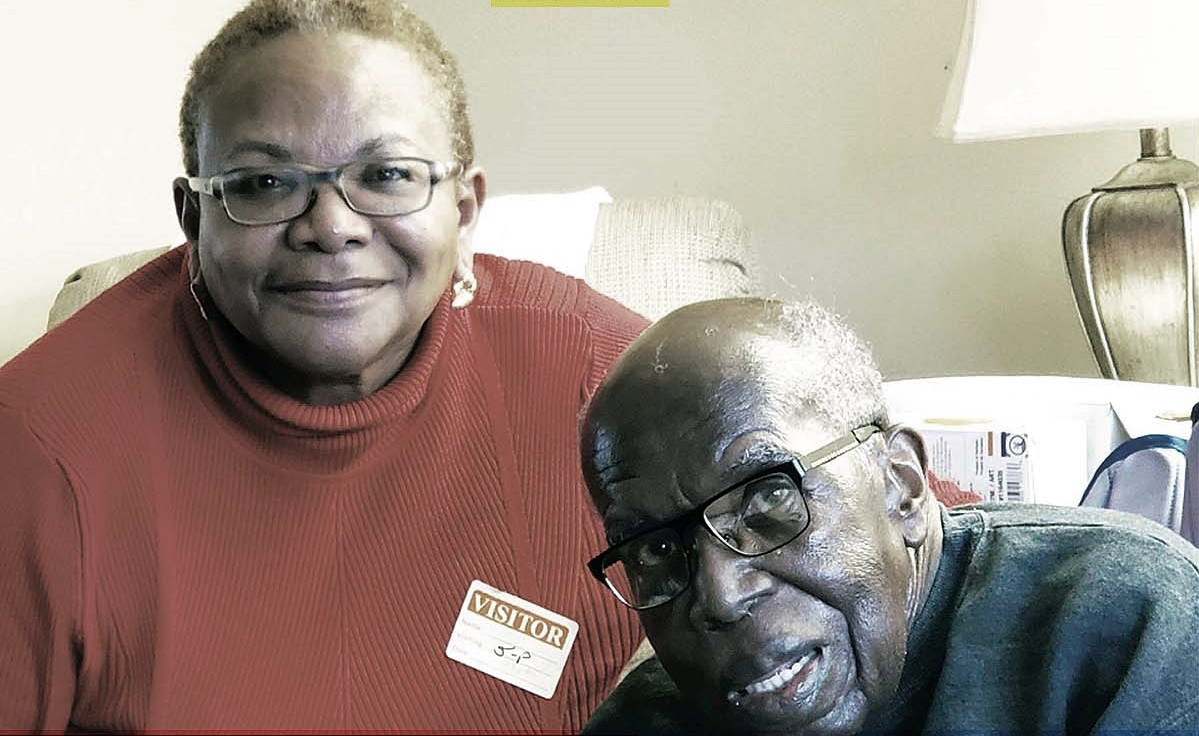
Eventually he moved to the mainland to facilities that could provide the nursing care he needed, first in Boston and then in Maryland. He had many visitors from the Virgin Islands, including Petersen and Valerie Doute, the office manager for the Catholic Chancery on St. Thomas.
“This was 26 years ago today that he hired me,” Doute said Friday.
“He was great,” she said, although he was “old school.” He wrote his homilies out by hand and she typed them.
“His handwriting was horrible,” she recalled with a laugh. Of course, he was more than a boss.
“He was such a gentle soul, he really was. I could talk to him about anything,” she said.
Doute and her husband were in Virginia at Christmas time, and made a side trip to visit Thomas. He had advanced Parkinson’s Disease and had suffered stokes and needed help to get in and out of bed.
“It was really heart-breaking,” she said. But also heart-warming to see him. His mind was sound and so was his spirit.
In his Pride magazine interview, Thomas recalled a memorable episode from his childhood. He was only six. His 12-year old brother was critically ill and one night he calmly told their mother that Jesus had told him he was about to die. It was all very natural.
“From that time,” Thomas said, “I wasn’t afraid of death.”