

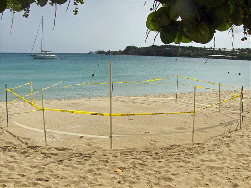
 About 200 tiny new guests are going to emerge on two St. Thomas beaches any time now, and volunteers are needed to monitor their activity. It’s a rewarding job, with excitement for those on patrol when turtle hatchlings show their faces, and all volunteers will get a mini-course in marine biology.
Renata Platenberg, wildlife biologist at the Fish and Wildlife Division of the Planning and Natural Resources Department, said Thursday, "We are into the time window now, as of Monday."
Erica Palmer, Coral World assistant curator of exhibits, and Platenberg are the watch coordinators.
Late on July 13, a leatherback mom made her way up the quiet beach at Brewers Bay to lay her eggs, and the next night Island Beachcomber Hotel guests were treated to the spectacle of a 600-pound leatherback lumbering up the beach at Lindbergh Bay, taking about two hours to lay her eggs.
It’s unusual for leatherbacks to lay their eggs on St. Thomas, particularly on south-facing beaches. Leatherbacks usually prefer broader beaches, like those found on St. Croix or Culebra, Platenberg said. "In recent history there haven’t been any leatherbacks on south side beaches," she said.
"The mother digs a nest about three feet deep," Platenberg said. "So when the babies make they way up the sand column they’ll stop and sit there and wait until the sand cools down, which indicates it’s night time.
"They come out in the dark to avoid predators," she explained. "They run around in different directions looking for a bright spot on the horizon. They are oriented by the electromagnetic force of the earth to navigate. In order to build up their kind of global positioning map, they have to make it from the nest to the water by themselves."
After the babies have gone to sea, Platenberg said, "We’ll excavate the nesting chamber, to see how many actually hatched, which ones were non-fertilized eggs, and which didn’t develop properly."
The watches have already started. "Monday night was the first," Platenberg said. "From then to the third week in September is when they should hatch. We had our first training class Monday with about 30 volunteers and another last night with only five."
The instructions are fairly simple. Platenberg said, "Basically, we provided information on what a turtle nest is, what sea turtles are, and what to expect. The watches are from 6 p.m. to 10 p.m. The main instruction is "don’t touch."
"It’s natural to want to pick them up," Platenberg said.
"And no lights. Light disorients them. When they see the babies beginning to come out, volunteers are instructed to call Erica who will start the telephone chain of those to be notified, including underwater photographer Paul Deaton, who will take pictures with his night camera which doesn’t use a flash."
The reward for patience is well worth it, Platenberg said. "I watched a nest hatch at Sandy Point on St. Croix, and it’s exciting — really, really cool. They come out like a volcano, the first one stimulates the next to hatch. They’re fast little sprinters."
And the volunteers will get free biology lessons on the beach. "My staff will talk about the turtles, or other marine life, and I’ll bounce back and forth like a ping pong ball between the two beaches," Palmer said.
"We had some Montessori kids here earlier in the week," she said. "There are all sorts of volunteers, young, old. It’s a chance for people to talk to each other about the sea. A lot of people don’t understand, they don’t really know the nitty-gritty about marine life. They are all passionate about the hatchlings doing well."
Platenberg said the hatchlings are tiny, about 3-1/2 inches long, and weighing just a few ounces. "On their own, they really don’t stand much of a chance in their natural environment, with predators all about. Their best bet is to find a piece of floating seaweed and hide beneath that."
The babies are too tiny to track. "Only recently," Platenberg said, "have satellites been able to track the adults. They circumnavigate the globe. They go everywhere, England, Australia, and the warm waters of the Caribbean."
To volunteer call 690-5551.